
The DJI Aerial Travel Kit: How to Film Your Adventures Like a Pro
A compelling aerial shot does more than document a trip — it reframes the entire experience. DJI has quietly become the default tool for anyone serious about capturing travel at a cinematic level, and this guide explains exactly why.
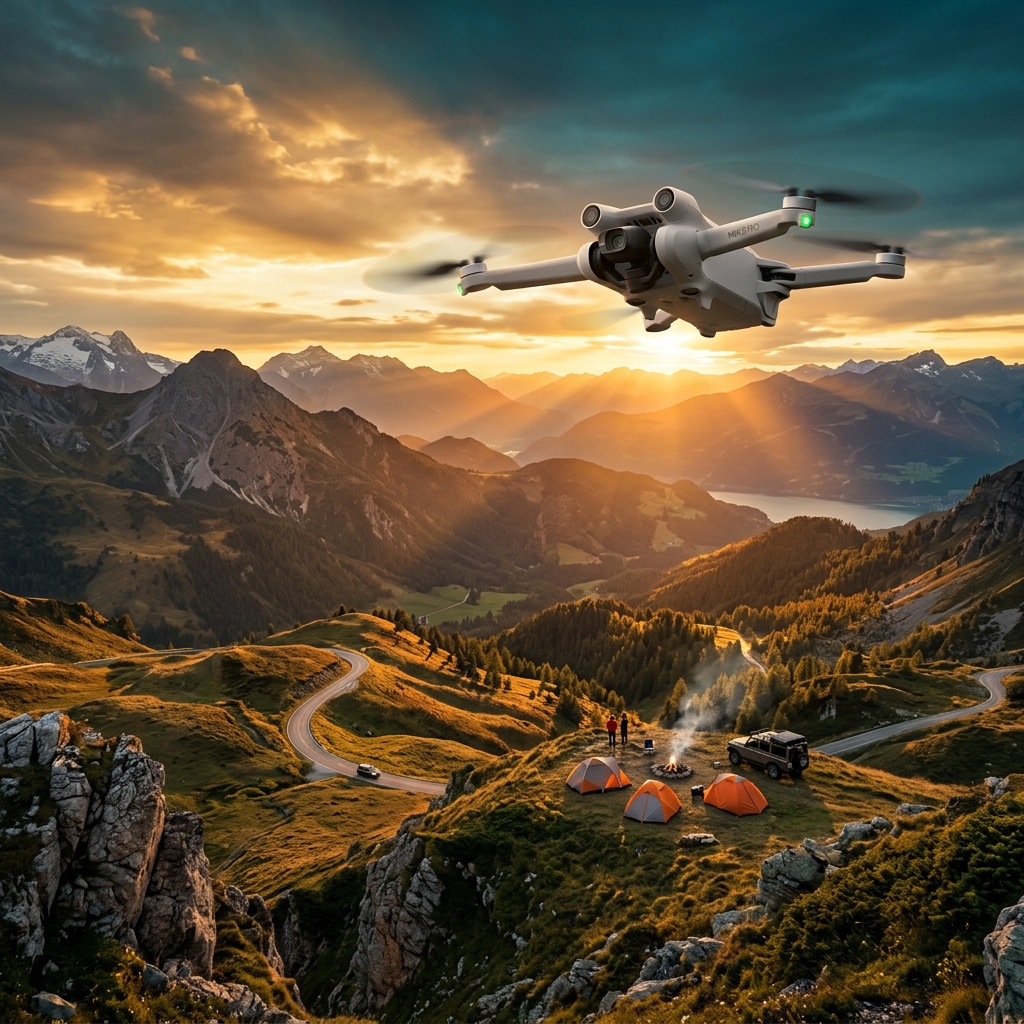
There is a moment on every great trip that demands more than a smartphone. You are standing at the edge of something vast — a canyon, a coastline, a mountain valley at golden hour — and you know the photo you are about to take will never do it justice. The angle is wrong. The scale is missing. The story is invisible.
This is the moment DJI was built for.
Over the past decade, DJI has transformed aerial photography from a niche hobby requiring commercial licenses and five-figure budgets into something any serious traveler can carry in a daypack. The technology has matured to a point where the barrier to entry is now almost entirely psychological, not technical. The drones fly themselves; what remains is the decision to bring one.
Why Aerial Footage Changes the Story
Ground-level photography is inherently limited by your physical position. You are always *inside* the landscape, never above it. The result is that most travel photos look remarkably similar — a person in the foreground, a landmark behind them, a sky overhead.
Aerial footage inverts this entirely. From 200 feet, you are suddenly seeing the geometry of a place: the way a river bends around an ancient village, how a hiking trail switchbacks up a ridge, the sheer mathematical beauty of a coastline from above. It adds a layer of context that ground photography simply cannot provide.
This "Cinematic Context" is not just an aesthetic preference. It is, psychologically, how we *remember* great travel. The mental snapshots we carry for decades are not typically the close-up portrait shots — they are the wide, sweeping moments that communicate scale and isolation. A DJI drone gives you those moments on demand.
Understanding the DJI Product Line for Travelers
DJI has segmented their lineup intelligently, and choosing the right tool matters more than most guides acknowledge. The wrong choice for your travel style will end up sitting in a bag.
The Mini Series: The No-Compromise Carry
The DJI Mini line (currently the Mini 4 Pro) is the gold standard for travel-first operators. It comes in under 249 grams — the critical weight threshold that exempts it from registration requirements in many jurisdictions, including the US and most of Europe.
What this matters: When you land in a foreign country and realize you forgot to research local drone registration laws, being under that threshold buys you enormous legal flexibility. It is the difference between worrying and flying.
Beyond compliance, the Mini 4 Pro shoots 4K video at up to 100fps, includes an omnidirectional obstacle avoidance system, and offers 34 minutes of flight time per battery. For a traveler shooting outdoor adventures, this spec sheet is essentially complete.
The Air Series: The Resolution Upgrade
The DJI Air 3 is the natural step up for those who want more creative control. It has a dual-camera system (a 1/1.3-inch main sensor plus a 3x telephoto), which allows you to compress backgrounds, isolate subjects, and create footage with a more "cinematic" depth of field.
Where the Mini series is about coverage (getting the shot reliably), the Air series is about craft (getting the exact shot you envisioned). If you are producing content for an audience — YouTube, Instagram, a film project — the Air 3 earns its extra weight.
The Osmo Pocket 3: The Stabilized Ground Camera
Not all travel content is aerial. DJI's Osmo Pocket 3 is a gimbal-stabilized camera the size of a smartphone that produces footage with a smoothness no handheld video can match. It is the ideal complement to a drone: while the drone handles the epic wide establishing shots, the Pocket 3 handles the intimate ground-level storytelling — the market stall, the conversation, the campfire.
Used together, they cover every frame of a documentary-quality travel film.
The Workflow: How Serious Travelers Pack DJI Gear
The biggest failure point for drone owners is workflow friction. If setting up the drone requires unpacking multiple cases, charging multiple devices, and reading multiple instructions, it will stay in the bag 90% of the time.
The solution is to build a universal kit and leave it pre-configured.
The Minimal Kit (Mini 4 Pro as Primary)
- 1× DJI Mini 4 Pro (in fly more combo for extra batteries)
- 1× 65W GaN charger with multi-port hub
- 1× DJI RC-N2 controller (folded, fits any camera bag side pocket)
- Filters: ND8, ND16, ND64 (for golden hour and bright midday shots)
Total carry weight: under 800g. This fits in the internal organizer of most daypacks or camera bags.
The Pre-Flight Checklist
Every professional aerial operator follows a ritual before launching. For the traveler, the ritual should take under 4 minutes:
- Unfold the drone; check propellers for damage or debris
- Power on drone and controller; wait for GPS lock (8+ satellites)
- Check local airspace in the DJI Fly app (the geo-fencing system will alert you to restrictions)
- Set the return-to-home altitude to 50m minimum
- Verify battery percentage on all three cells
Following this sequence every time, without shortcuts, prevents the common accidents that most beginners experience.
The Legal Reality: Flying Abroad Without Stress
Many travelers avoid bringing a drone internationally because they fear regulatory complexity. The concern is legitimate but manageable.
The key resource is UAV Coach's global drone laws database, updated monthly, which shows registration requirements by country. As a rule:
- Under 249g (Mini series): Exempt from registration in most EU countries, UK, US, Canada, Australia, and Japan
- Over 250g: Requires registration and, in many countries, a basic operator certificate (usually a simple online exam)
The Mini 4 Pro's sub-249g design was not accidental. DJI engineers it specifically to make international travel legal by default. For most travelers, the only real homework is checking national park and urban flight restrictions — and for that, the DJI Fly app's built-in airspace map does the work for you.
Shot Types That Are Worth the Effort
The difference between mediocre and compelling aerial footage is rarely hardware; it is technique. A few shot types that reliably produce professional results:
The Reveal Shot: Begin with the drone pointed at the ground, moving backward and upward. Slowly tilt the camera up until the full landscape is revealed. This works at any scale — a campsite, a city, a mountain range — and creates an immediate sense of drama.
The Orbit: Use the automated Orbit QuickShot to circle a landmark at a fixed altitude. The drone does the flying; you just set the radius and speed. The result looks like something from a documentary.
The Hyperlapse: The DJI Fly app's Hyperlapse modes (Free, Circle, Course Lock) compress time into 30-second clips that turn long sunsets or tide changes into visual anchors for a travel film.
The Tracking Shot: Use ActiveTrack to follow a car, a hiker, or a kayak. The drone maintains lock even when the subject moves. This technique is difficult to execute manually but becomes trivially easy with DJI's subject tracking stack.
Where to Buy: DJI USA
If you are ready to invest in aerial capability, the most reliable source is DJI's official US store. Buying direct ensures you receive authentic hardware with full US warranty coverage, access to DJI Care Refresh (their accident replacement program), and the current software versions without resale delays.
DJI also bundles their products into Fly More Combos, which include extra batteries, ND filter sets, and carrying bags at a meaningful discount over buying components separately. For a first purchase, the combo is almost always the right choice — the extra batteries alone transform the experience from a single 30-minute window into a full afternoon of flight.
The Honest Verdict
A DJI drone is not for everyone. It rewards travelers who see documentation as part of the trip experience — people for whom the process of finding the frame, understanding the light, and editing the footage is itself a form of leisure and craft.
For that type of traveler, no other tool in the bag will have a higher return per dollar. The footage you bring home from a DJI-equipped trip is not just a record; it is an argument for the trip's existence. It is proof that the valley was that wide, the sunset was that color, the coastline was that remote.
It turns memory into evidence.
If you have been on the edge of this purchase, the honest advice is: buy the Mini 4 Pro Fly More Combo, learn two shots, and take it on your next trip. The learning curve is a weekend. The footage dividend lasts a lifetime.